


When using cutting coolant, the focus is often solely on performance once the fluid is in use on the machine—whether machining results are optimal, tool life is extended, or the emulsion appears stable. However, there are two initial phases that are actually critical to the final outcome: the concentrate and the blooming phases.
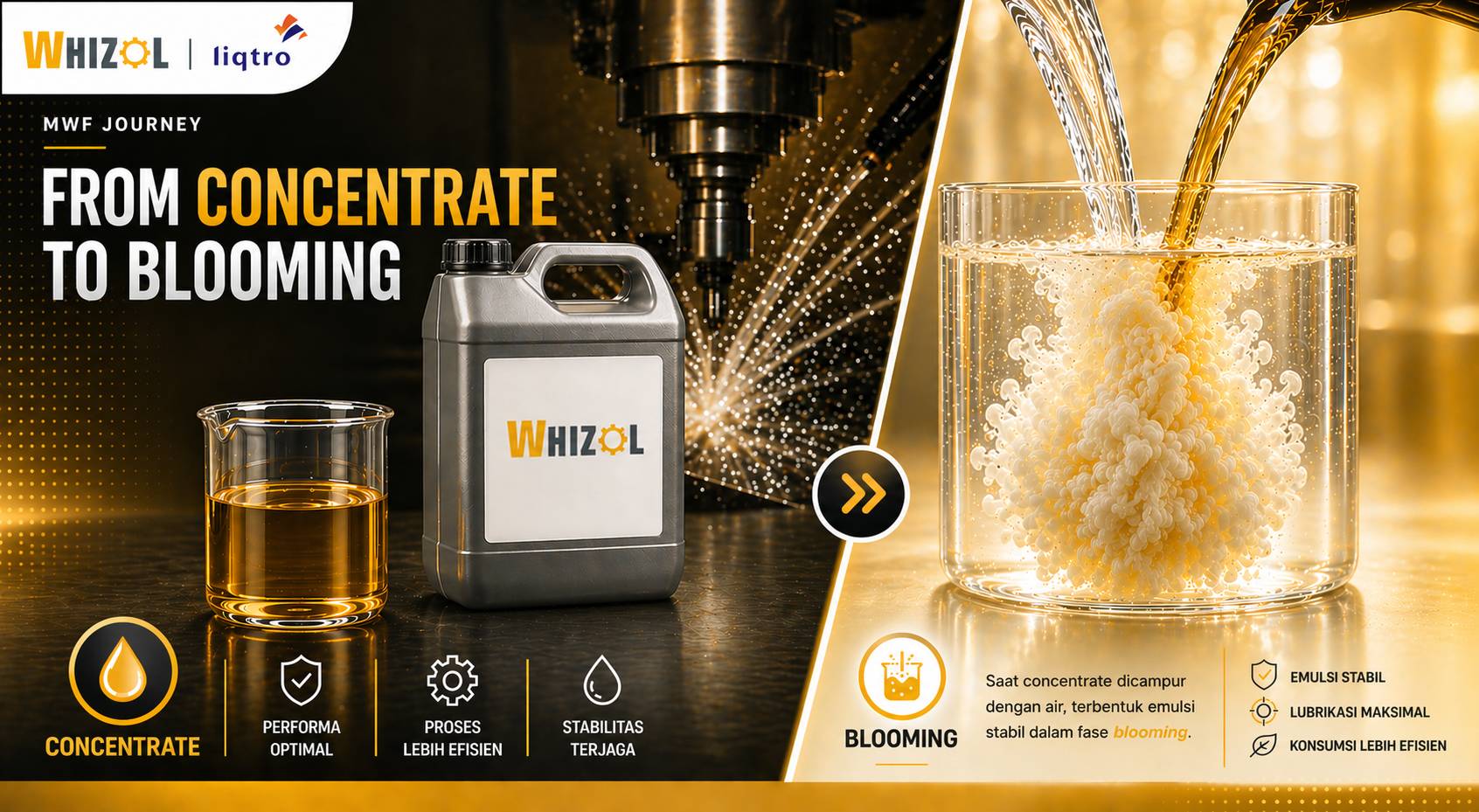
The concentrate phase is the initial form of the coolant before it is mixed with water. At this stage, all the main components—such as base oil, emulsifier, and various additives—have been formulated into a balanced system. This balance is crucial, as it determines how the coolant behaves when used. Imbalances in the formulation or incompatibility between components are often not immediately apparent at the start but only emerge after the coolant is applied, for example, in the form of an unstable emulsion or inconsistent performance.
Next, the blooming phase occurs when the concentrate is mixed with water to form an emulsion. This is where the coolant begins to “actively” work. This process involves dispersing oil into water with the help of an emulsifier, forming small droplets to keep the emulsion stable. A successful blooming result is characterized by a homogeneous emulsion that does not separate easily and is ready for optimal use.
Conversely, suboptimal blooming is immediately evident from an uneven emulsion, the appearance of an oil layer on the surface, or the separation of the oil and water phases within a short period of time. Interestingly, blooming quality depends not only on the product but is also significantly influenced by field practices.
Key factors affecting blooming success include water quality, mixing methods, and agitation processes. Water with high hardness levels can impair emulsifier performance. Additionally, the correct mixing method involves adding the concentrate to the water, not the other way around. Sufficient agitation is also necessary to ensure optimal oil dispersion.
Concentration is another critical parameter. Too low a concentration can reduce protection and performance, while too high a concentration can lead to waste and issues such as foaming.
Ultimately, the performance of cutting coolants is determined not only by product quality but also by how these initial two phases are executed. Understanding and controlling the concentrate and blooming processes can be the key to improving performance without having to change the product—simply by refining the basic processes that are often overlooked.
#SmartLubricationByWhizol #WhizolOilExpert #LiqtroOilSolution #LiqtroSpecialtyLubricant #CuttingCoolant
Anastasia Levina
Contact Us!
Email: sales@whizol.com
IG: https://instagram.com/whizol
Facebook: https://facebook.com/whizol
www.whizol.com
Share this Article